

Practising electronic drums in student housing is realistic — as long as you manage three things: sound, floor vibration, and timing or housing rules. With headphones the module sound stays with you, mesh pads soften the stick strike, a mat catches the kick thump, and an agreed routine keeps the peace. None of that makes a kit silent or automatically allowed, so the setup and the schedule matter equally.
Right now, the Back to School Sale includes electronic drum kits that fit a student room and a student budget. Use it as your starting point, then read on for what actually controls the noise.
Where the Sound Really Comes From: Headphones, Pads and the Floor
With headphones, the module sound stays with the player. Your kit's module produces the drums, cymbals and any play-along tracks, and when you plug in, all of that goes to your ears — so a late session does not have to be a loud session.
What still travels is physical: the stick strike on the pads and the kick-pedal thump through the floor. Mesh-head pads are quieter on stick strike than rubber pads, and a rug or mat under the kit softens the pedal thump while protecting the floor underneath.
The honest version: quieter is not the same as silent, and no electronic kit is automatically allowed in student housing. Headphones, mesh pads and a mat reduce the sound; your routine and the housing rules decide whether practice is acceptable.
Fit a Kit into a Small Student Room
Yes — a compact kit fits a small student room. Compact sets sit on a desk or in a corner with the pedals at floor level, which is more than an acoustic drum kit could ever claim in a shared flat.
Foldable racks let a full kit be packed down for storage between sessions — useful when your room doubles as a bedroom, a study and a kitchen corner.
And because student rooms often change each term, portability counts: a kit that runs on a USB power bank can follow you to wherever space is available, without hunting for a wall socket.
Agree a Routine: Timing, Flatmates and Housing Rules
The gear only gets you halfway — the routine decides whether practice stays welcome. Practise during the day and agree set hours with flatmates, so everyone knows when the sticks come out.
Check the tenancy or accommodation rules before you set up. Some student housing restricts instruments or requires you to use a practice room, and it is far easier to know that rule before you start than to argue about it mid-term.
Talk to flatmates or neighbours early. A short heads-up that you are setting up an electronic kit — and that it runs on headphones — builds goodwill before a single note is played.
Five E-Drum Kits from the Donner Back to School Sale
Once the room, the routine and the rules are sorted, a compact or foldable mesh kit is the practical next step. All five kits below practise through headphones and use mesh pads to soften the strike — quieter, not silent, and never a guarantee of permission. The cards run from the most compact and portable to the more complete setups, so start with the space you have.
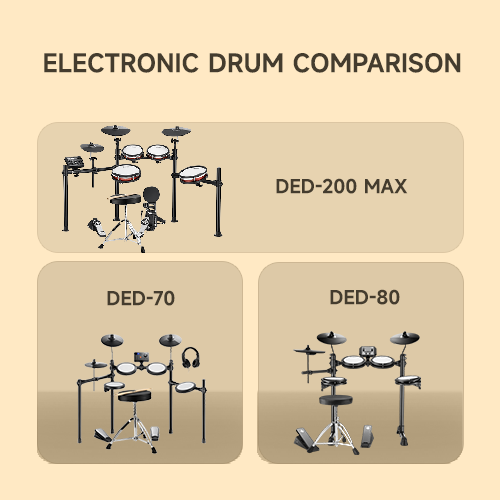
Donner DED-70 Junior Electronic Drum Kit Most portable for small rooms

Features
- Compact 4-drum 3-cymbal kit with mesh snare and tom pads for quieter stick strikes
- 150 built-in sounds with headphone output for quiet sessions
- Runs on the included adapter or a USB power bank
- Collapsible metal rack; headphones, drum throne and sticks included
- USB-MIDI and AUX input for playing along with tracks
The Donner DED-70 Junior Electronic Drum Kit is the most portable option for a small shared room: a compact 4-drum 3-cymbal setup with mesh snare and tom pads, a collapsible metal rack, and power from the included adapter or a USB power bank. Headphones, a drum throne and sticks are included, so it is ready to play straight out of the box.
Donner DED-80 Beginner Electronic Drum Kit Best foldaway beginner kit

Features
- 4-drum 3-cymbal beginner kit with mesh snare and tom pads
- 180 sounds across 15 drum kits with a 3-digit LED display
- Foldable rack that stores compactly in limited space
- Headphone output, plus headphones, drum throne and sticks included
- USB-MIDI and AUX input for learning and play-along
The Donner DED-80 Beginner Electronic Drum Kit pairs a full-feeling mesh-pad setup with a foldable rack that stores compactly when space is tight. The 4-drum 3-cymbal layout with mesh snare and tom pads keeps stick strikes down, while the 180 sounds across 15 drum kits give beginners plenty to explore with headphones keeping the sound in your ears. Headphones, drum throne and sticks are included.
Donner DED-200X Electronic Drum Set Best value 5-piece mesh kit

Features
- 5-drum 4-cymbal kit with an 8-inch mesh snare and mesh toms
- 450 sounds across 31 drum kits
- Foldable 4-post aluminium rack; headphones and drum throne included
- Dual-zone cymbals with choke for more expressive practice
- USB-MIDI, metronome and sequencer for structured practice
The Donner DED-200X Electronic Drum Set is the step up when a little more floor space is available: a 5-drum 4-cymbal kit with an 8-inch mesh snare and mesh toms, dual-zone cymbals with choke for expressive practice, and a foldable 4-post aluminium rack. With 450 sounds across 31 drum kits plus USB-MIDI, a metronome and a sequencer, it supports structured practice in a student room.
Donner DED-200 MAX Electronic Drum Kit Most complete all-included bundle

Features
- 5-drum 3-cymbal kit with a 10-inch mesh snare and mesh toms
- 450+ sounds with headphone output for quiet sessions
- Complete bundle: drum throne, headphones, sticks and cables included
- Foldable 4-post stand with AUX input and metronome
The Donner DED-200 MAX Electronic Drum Kit is the most complete all-included bundle here: a 5-drum 3-cymbal kit with a 10-inch mesh snare and mesh toms, 450+ sounds, and everything you need to start — drum throne, headphones, sticks and cables included. The foldable 4-post stand packs down between sessions, and the AUX input and metronome keep practice structured.
Donner DED-200 Pro Electronic Drum Set Best for serious quiet practice

Features
- All-mesh drum heads for a quieter, more natural playing feel
- 450 sounds across 31 drum kits
- Practice tools: metronome, recorder, sequencer, 50 built-in songs, AUX input and MP3 playback
- Bluetooth connectivity for playing along with tracks
The Donner DED-200 Pro Electronic Drum Set is the choice for serious quiet practice: all-mesh drum heads give a quieter, more natural playing feel, and the 450 sounds across 31 drum kits sit alongside deeper practice tools — metronome, recorder, sequencer and 50 built-in songs. AUX input, MP3 playback and Bluetooth let you play along with tracks without turning practice into a loud event.
Quick Answers
Will the kick pedal annoy the people below me? The module sound stays in your headphones, but the pad thump and the pedal vibration still travel through the floor. Put a mat or rug under the kit and agree timing with the people below you — practise during the day and keep sessions within set hours.
Is an electronic kit allowed in student housing at all? It depends on the accommodation rules. Check your tenancy or housing agreement before setting up, and if instruments are restricted, find out whether your accommodation or campus offers a practice room.
Start the term with a routine that works: pick the kit that fits your room, keep the sound in your headphones and a mat under the pedals, and agree your practice hours early. Then browse the Donner Back to School Sale to find the kit that fits your room and your budget.